
How Paycheq estimates tax
Paycheq estimates the federal and provincial tax, CPP and EI on each cheque with the Canada Revenue Agency’s payroll formulas, the same ones employers’ payroll systems use.
What it uses
- CRA’s T4127 Payroll Deductions Formulas, for your province of employment.
- The tables in effect on your payday. Rates and amounts change each January 1, and some change again on July 1. Paycheq switches on the right date.
- Your settings: Province for tax, Pay frequency, your TD1 claims, and anything under Each cheque, such as RRSP, union dues, extra tax withheld, taxable benefits and other deductions.
- Your year to date, so CPP and EI stop at the yearly maximum.
Seeing the working
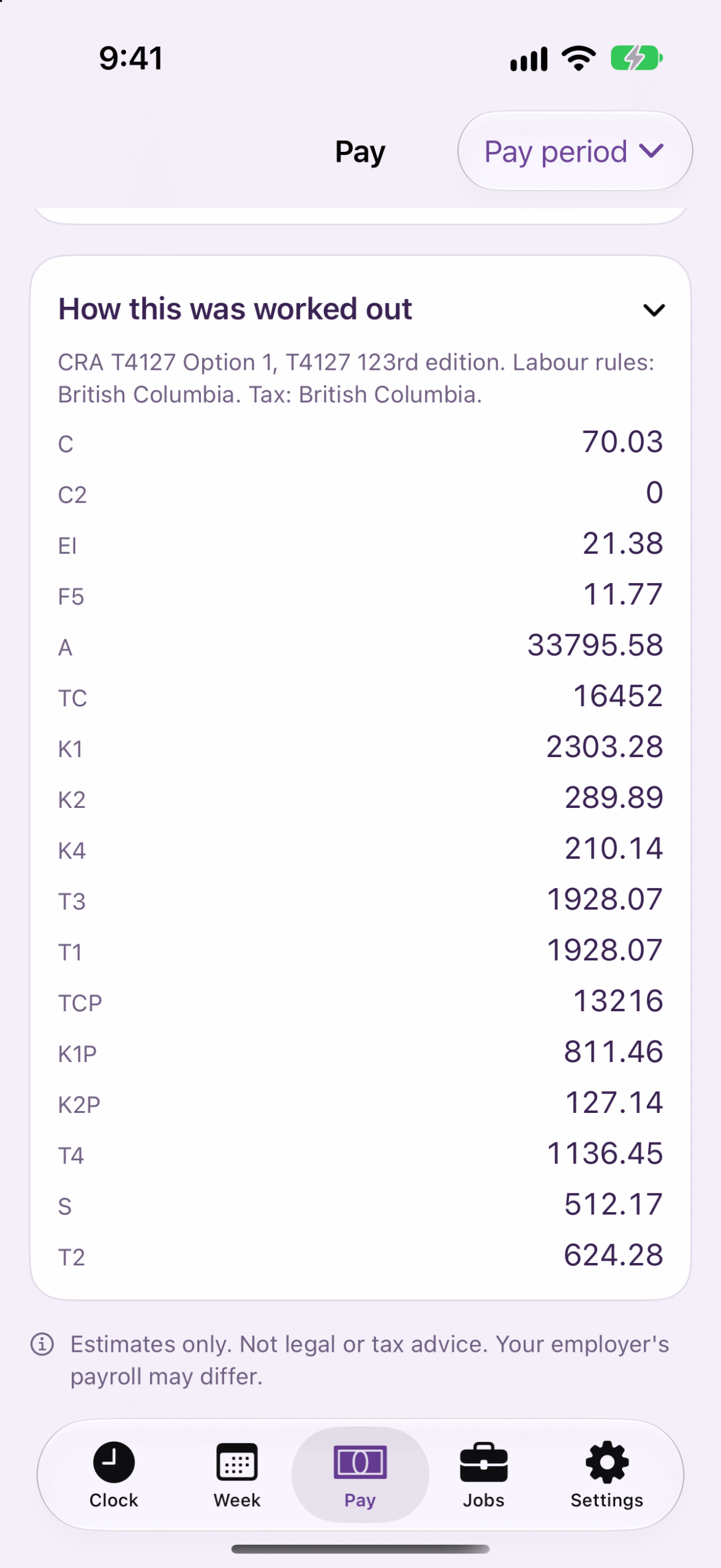
On the Pay tab, open a pay period and scroll to How this was worked out. It shows each step of the formula, and which tables and rules were used.
While a pay period is still going
Deductions use the rate for a cheque of about your recent average, so they don’t jump each time you add a shift. Once the period ends, they’re worked out on the real total.
Why it can differ from your cheque
Some employers use CRA’s tables instead of the formulas, round in a different order, or take deductions Paycheq doesn’t know about. See Why your estimate can differ from your cheque.
Good to know
- Bonuses and other lump sums can be taxed differently by your employer.
- Retro pay is taxed by CRA’s method for retroactive pay increases.
- Quebec isn’t supported yet.
- Official source: https://www.canada.ca/en/revenue-agency/services/forms-publications/payroll/t4127-payroll-deductions-formulas.html
Estimates only. Not legal or tax advice.
Also useful → Why your estimate can differ from your cheque
- Next in Getting Started →Setting up your first job
- Next in Getting Started →Your pay schedule from your last cheque
- Next in Getting Started →Clocking in and out
- Next in Getting Started →Entering a shift by hand
- Next in Getting Started →Reading the Week screen
- Next in Getting Started →Clock-in and clock-out reminders
- Next in Getting Started →Working more than one job
- Next in Getting Started →Your widget and Live Activity
- Next in Getting Started →Checking your first cheque
- Next in Your pay →Reading the Pay screen
- Next in Your pay →Why your estimate can differ from your cheque
- Next in Your pay →Entering a cheque stub
- Next in Your pay →CPP and EI and the yearly maximums
- Next in Your pay →Adding pay from before you started using Paycheq
- Next in Your pay →Vacation pay
- Next in Your pay →Exporting shifts and pay summaries
- Next in Overtime and rates →The overtime window (such as midnight to 6 a.m.)
- Next in Overtime and rates →Saturday, Sunday and other day rates
- Next in Overtime and rates →Daily and weekly overtime
- Next in Overtime and rates →Shifts entered at 1.5× or 2×
- Next in Overtime and rates →The rate highlighted on the Clock card
- Next in Overtime and rates →Other rates, such as a lead rate
- Next in Overtime and rates →Raises and retro pay
- Next in Union contracts & custom rules →Setting up your contract rules
- Next in Union contracts & custom rules →The long-shift meal premium
- Next in Union contracts & custom rules →Call-out minimums
- Next in Union contracts & custom rules →How does banked time work?
- Next in Union contracts & custom rules →When more than one rule applies
- Next in Union contracts & custom rules →Working two rates in one shift
- Next in Union contracts & custom rules →Paid breaks and unpaid meal breaks
- Next in Union contracts & custom rules →Shift premiums and on-call pay
- Next in Holidays →How holiday pay works
- Next in Holidays →Your contract's own holidays
- Next in Holidays →How do my two vacation balances work?
- Next in Holidays →Holidays in Alberta
- Next in Holidays →Holidays in British Columbia
- Next in Holidays →Holidays in Manitoba
- Next in Holidays →Holidays in New Brunswick
- Next in Holidays →Holidays in Newfoundland and Labrador
- Next in Holidays →Holidays in the Northwest Territories
- Next in Holidays →Holidays in Nova Scotia
- Next in Holidays →Holidays in Nunavut
- Next in Holidays →Holidays in Ontario
- Next in Holidays →Holidays in Prince Edward Island
- Next in Holidays →Holidays in Saskatchewan
- Next in Holidays →Holidays in Yukon
- Next in Holidays →Holidays in the federal sector
- Next in Your data →Backing up and restoring
- Next in Your data →Using a flat tax percentage
- Next in Your data →Union dues
- Next in Your data →How Paycheq estimates tax
- Next in Your data →TD1 claim amounts
- Next in Your data →Your data stays on your phone
- Next in Paycheq Pro →What Paycheq Pro adds
- Next in Paycheq Pro →Restoring a purchase
- Next in Paycheq Pro →If your Pro subscription ends
- Next in Troubleshooting →My figures don't match my cheque
- Next in Troubleshooting →A backup won't restore