
Checking your first cheque
When your first payday with Paycheq comes, take two minutes to compare your real cheque with the estimate. It shows you how close Paycheq is for your job, and it keeps your CPP and EI totals right.
Before payday
Open the Pay tab. You’ll see the pay period you’re in now:
- Net so far while the period is still going, or Net estimate once it’s over.
- What you earned, by rate, and each deduction: federal and provincial tax, CPP, EI and anything else, such as union dues.
If a figure looks wrong before payday, check your shifts first. See My figures don’t match my cheque.
Entering your cheque stub
- Open the Pay tab. If you have more than one job, choose the job at the top left.
- Make sure Pay period is showing, then use the arrows to go to the pay period your cheque covers. The dates are at the top.
- Scroll to Your actual cheque and tap Enter cheque stub.
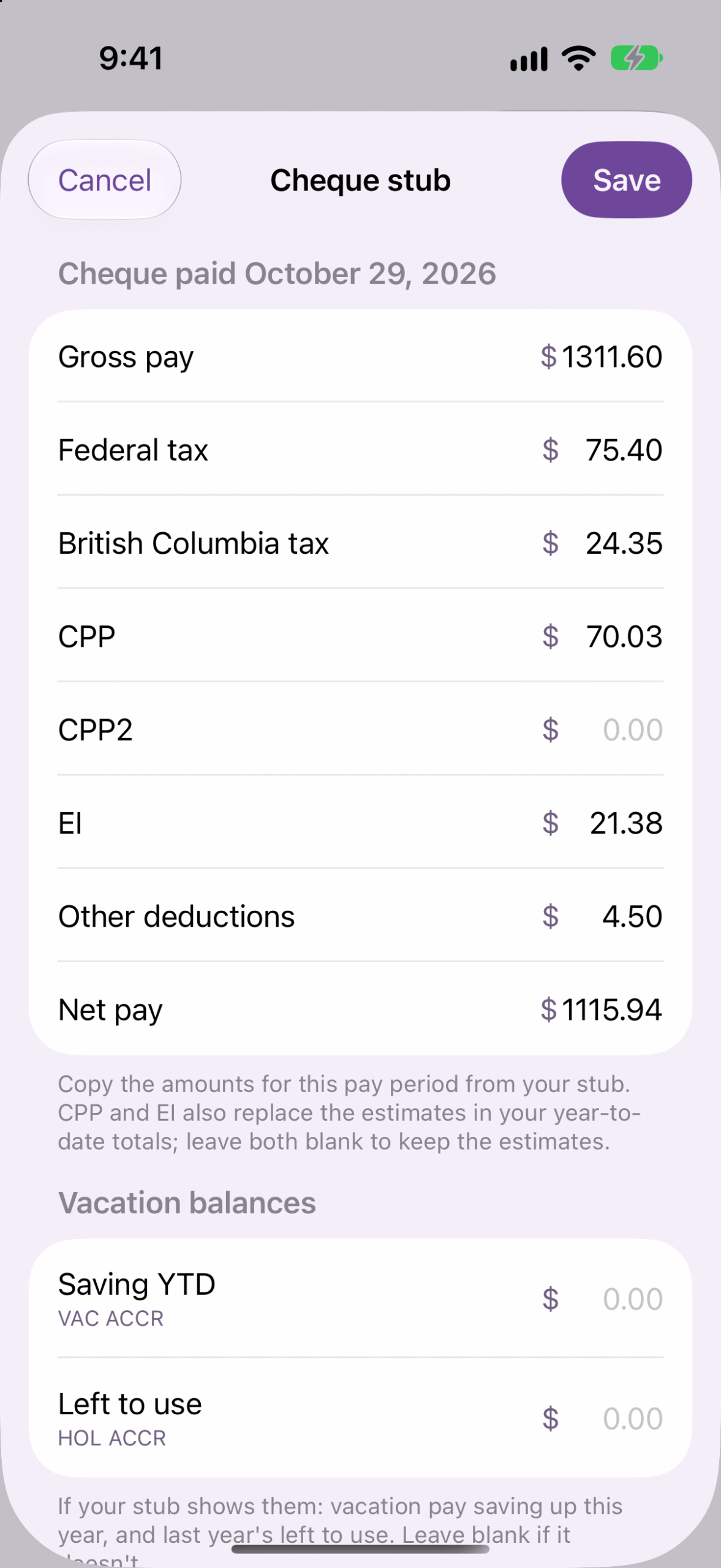
- Copy the amounts for this pay period from your stub: Gross pay, Federal tax, your province’s tax, CPP, CPP2, EI, Other deductions and Net pay. Only Net pay is needed. The rest help you see where any difference comes from.
- Tap Save.
Use the amounts for this cheque, not the year-to-date column.
Reading the result
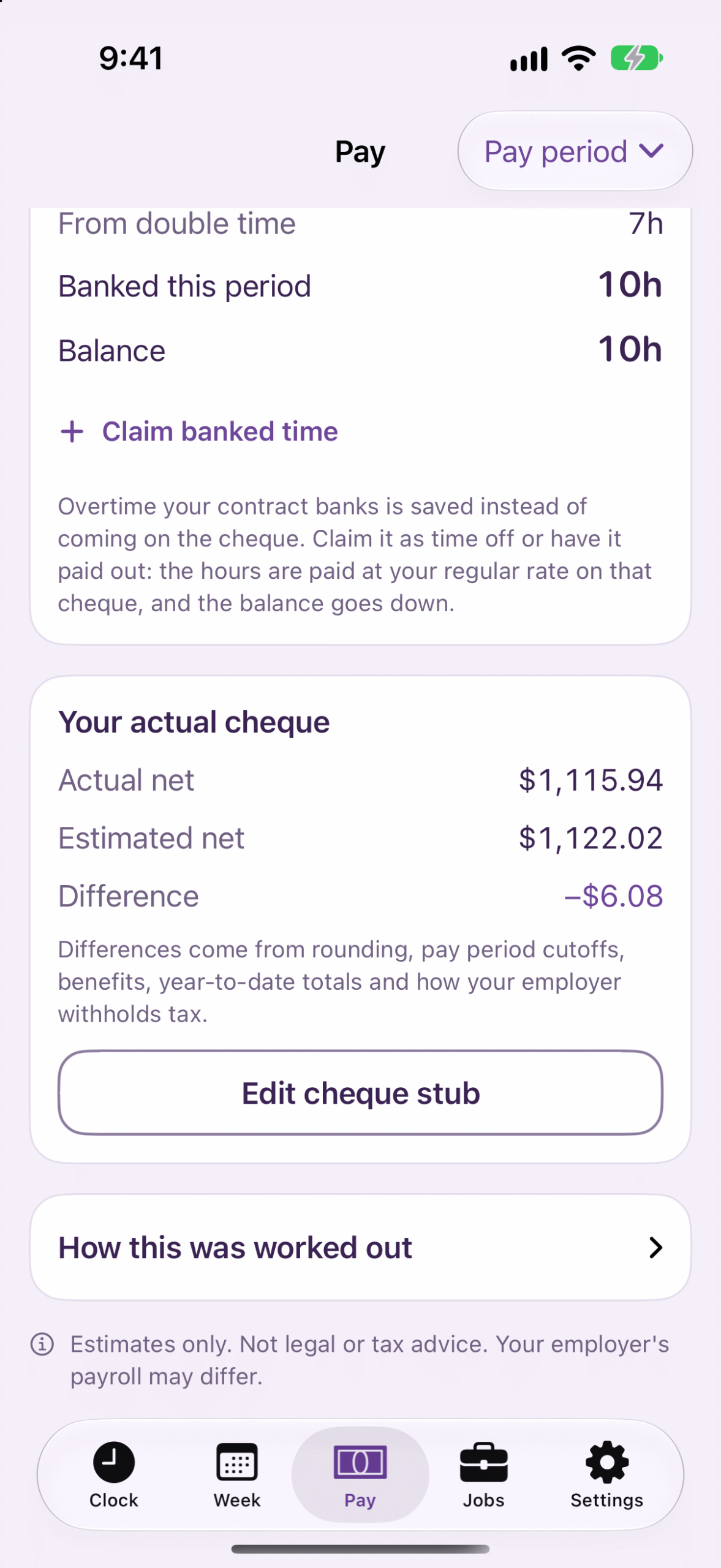
The Your actual cheque card now shows:
- Actual net: from your stub.
- Estimated net: Paycheq’s estimate.
- Difference: how much more (+) or less (−) your cheque was.
A difference of a few dollars is normal. It comes from rounding, pay period cutoffs, benefits, year-to-date totals and how your employer withholds tax. See Why your estimate can differ from your cheque.
A bigger difference usually means something to fix:
- Compare your hours with the stub. A missed shift, a break or the wrong rate on one shift shows up here.
- Compare the earnings line by line with the day screens in Week. Each day’s Paid table shows exactly how it was paid.
- Check your rules and holidays in Jobs.
What Paycheq does with it
- Correct CPP and EI totals: the CPP and EI you enter replace Paycheq’s estimates in your year-to-date totals, so they stop at the yearly maximum at the right time. Leave both blank to keep the estimates.
To change a stub, open that pay period and tap Edit cheque stub. To remove it, tap Delete cheque stub at the bottom.
Good to know
- Comparing with your cheque is part of Paycheq Pro. Stubs you entered are kept if Pro ends.
- If you started using Paycheq partway through the year, add your year-to-date amounts too, so CPP and EI are right from the start. Go to Jobs, tap your job, and fill in Earlier this year.
Estimates only. Not legal or tax advice.
Also useful → My figures don’t match my cheque
- Next in Getting Started →Setting up your first job
- Next in Getting Started →Your pay schedule from your last cheque
- Next in Getting Started →Clocking in and out
- Next in Getting Started →Entering a shift by hand
- Next in Getting Started →Reading the Week screen
- Next in Getting Started →Clock-in and clock-out reminders
- Next in Getting Started →Working more than one job
- Next in Getting Started →Your widget and Live Activity
- Next in Getting Started →Checking your first cheque
- Next in Your pay →Reading the Pay screen
- Next in Your pay →Why your estimate can differ from your cheque
- Next in Your pay →Entering a cheque stub
- Next in Your pay →CPP and EI and the yearly maximums
- Next in Your pay →Adding pay from before you started using Paycheq
- Next in Your pay →Vacation pay
- Next in Your pay →Exporting shifts and pay summaries
- Next in Overtime and rates →The overtime window (such as midnight to 6 a.m.)
- Next in Overtime and rates →Saturday, Sunday and other day rates
- Next in Overtime and rates →Daily and weekly overtime
- Next in Overtime and rates →Shifts entered at 1.5× or 2×
- Next in Overtime and rates →The rate highlighted on the Clock card
- Next in Overtime and rates →Other rates, such as a lead rate
- Next in Overtime and rates →Raises and retro pay
- Next in Union contracts & custom rules →Setting up your contract rules
- Next in Union contracts & custom rules →The long-shift meal premium
- Next in Union contracts & custom rules →Call-out minimums
- Next in Union contracts & custom rules →How does banked time work?
- Next in Union contracts & custom rules →When more than one rule applies
- Next in Union contracts & custom rules →Working two rates in one shift
- Next in Union contracts & custom rules →Paid breaks and unpaid meal breaks
- Next in Union contracts & custom rules →Shift premiums and on-call pay
- Next in Holidays →How holiday pay works
- Next in Holidays →Your contract's own holidays
- Next in Holidays →How do my two vacation balances work?
- Next in Holidays →Holidays in Alberta
- Next in Holidays →Holidays in British Columbia
- Next in Holidays →Holidays in Manitoba
- Next in Holidays →Holidays in New Brunswick
- Next in Holidays →Holidays in Newfoundland and Labrador
- Next in Holidays →Holidays in the Northwest Territories
- Next in Holidays →Holidays in Nova Scotia
- Next in Holidays →Holidays in Nunavut
- Next in Holidays →Holidays in Ontario
- Next in Holidays →Holidays in Prince Edward Island
- Next in Holidays →Holidays in Saskatchewan
- Next in Holidays →Holidays in Yukon
- Next in Holidays →Holidays in the federal sector
- Next in Your data →Backing up and restoring
- Next in Your data →Using a flat tax percentage
- Next in Your data →Union dues
- Next in Your data →How Paycheq estimates tax
- Next in Your data →TD1 claim amounts
- Next in Your data →Your data stays on your phone
- Next in Paycheq Pro →What Paycheq Pro adds
- Next in Paycheq Pro →Restoring a purchase
- Next in Paycheq Pro →If your Pro subscription ends
- Next in Troubleshooting →My figures don't match my cheque
- Next in Troubleshooting →A backup won't restore